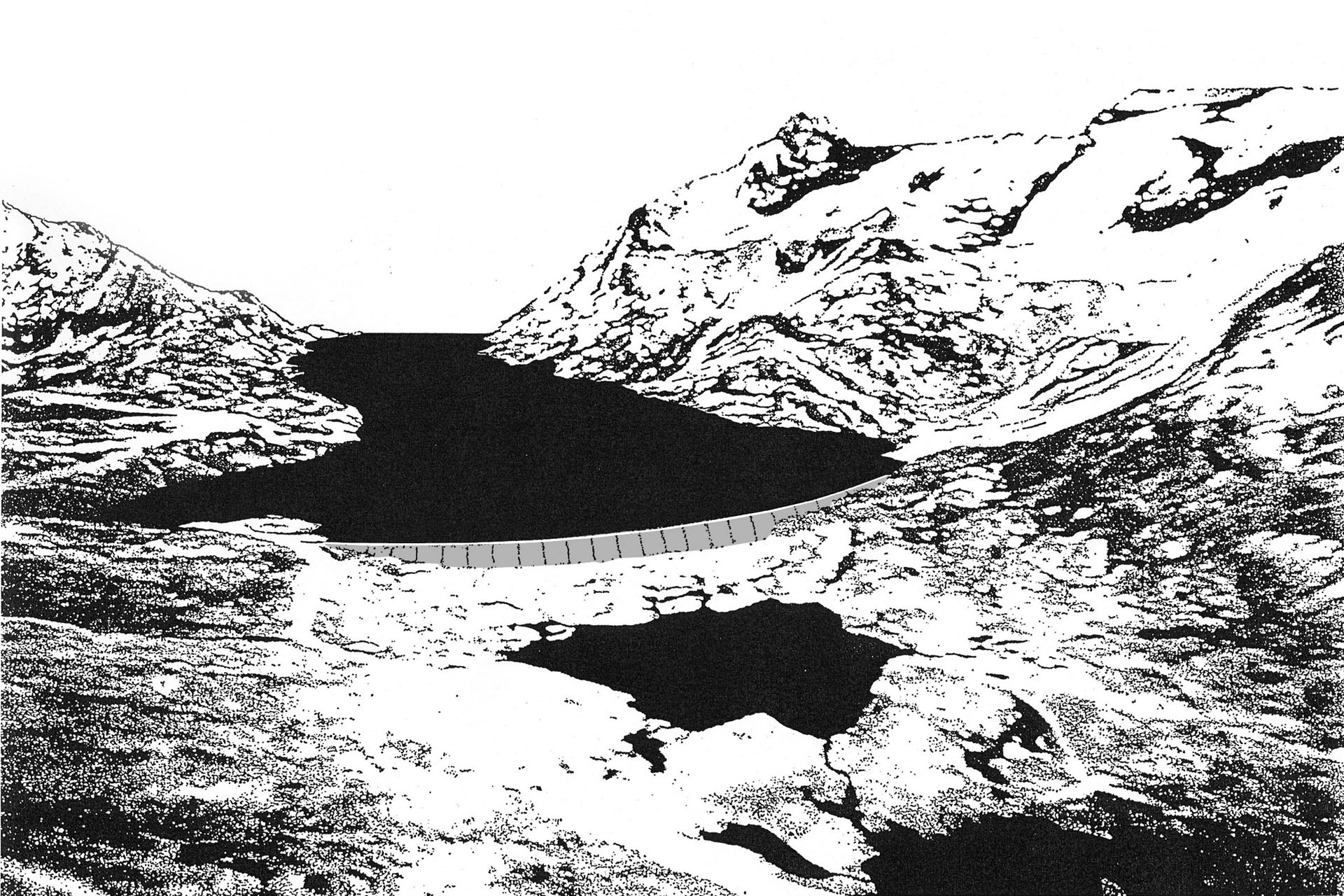
Lago Bianco Dams and Power Station Robbia
A true architectural project must always be a synthesis between responding to a program and responding to a site, and this synthesis must be firmly supported by structure. For various reasons, the engineers had planned the construction of a “gravity dam” that echoed the form of the existing concave-arch dam. What, then, could be the architect’s contribution? It was to provide continuity to the engineer’s work by representing his structural choice through a single gesture that best expressed its essence. If a concave concrete arch embodies a particular method of resisting water pressure, another arch—convex and made of a different material—embodies a different method of resistance. In essence, a structural system must have a clear, identifiable expression which, when paired with an equally precise concept of landscape design, can offer a path toward a successful solution to the challenges at hand. In this context, debates over whether the dam is too high, too long, too gray, or too artificial become irrelevant. The architect’s role becomes focused on the precision of the curve, the correct slope, and the nature of the transitions between human-made structures and the natural environment. As part of the expansion of the dams at Lago Bianco, plans were made to extend the Robbia power station, which included a new turbine hall and an SF6 switchyard: alongside the existing power station, which lies perpendicular to the slope, two further buildings were planned, arranged on a plinth parallel to the slope, marking the end of the Robbia plain. Although they differed in size due to their contents, they were designed with the same structure, consisting of a series of steel frames with light-permeable slots. With A. Galfetti